The Agent Says “There Are Multiple Offers”. Should You Panic? Or Believe Them?

Updated: 3 days ago
So, you’ve found the property. You like it, and you’re thinking about making an offer. Then the selling agent said "there are multiple offers" ...
Your heart sank. Should you panic? Or should you trust them? Either way can be a problem. And either way can help you too. In this article, we'll show you what you can do next. What you do next, can determine if you get the property you want.
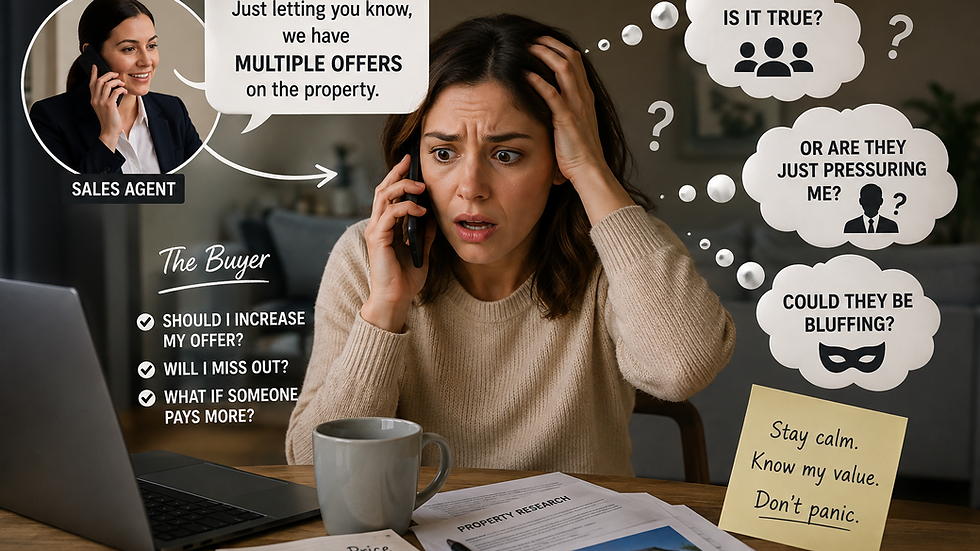
“Just letting you know, we’ve got multiple offers.”... Is probably the reply buyers dread from the sales agent. Suddenly everything changes. Do you increase your offer? Put something in immediately? Assume another buyer is about to take the property from you? Or do you roll your eyes and think:
“Yeah, right. Of course you do.”
After more than 20 years around Melbourne properties, I can tell you that neither reaction is particularly useful. Sometimes there genuinely are multiple offers. Sometimes there is considerably less competition than the agent wants you to believe.
The most important question isn't whether another buyer exists. It is not about whether there are any other offers. It is not about whether you should change your offer. It is whether another buyer should change what this property is worth to you.
First: Can An Agent Invent "Another Offer"?
No. An estate agent cannot simply fabricate competing buyers or offers to pressure you into paying more.
Consumer Affairs Victoria states that estate agents and agents' representatives must not engage in misleading or deceptive conduct, including through verbal representations.
The ACCC is even more direct: real estate agents must not mislead consumers in order to encourage higher offers. It specifically gives false representations about offers or prices as examples of conduct that can breach Australian Consumer Law.
So if an agent tells you: “We have another offer.” when no such offer exists, that isn't just clever salesmanship. It is more likely true than misleading or deceptive conduct. And here is where real life becomes more complicated.
What exactly does “multiple offers” mean?
Agents usually say:
“There are three other buyers with signed contracts offering roughly what you're about to offer.”
But that may not actually be what the agent said. “Multiple offers” could potentially describe very different situations. There might be two signed offers sitting in front of the vendor. Or there could be one written offer, another buyer who has verbally indicated a number, and somebody else saying they are “very interested”.
One offer might be $1.5 million. Another might be $1.35 million. One may be unconditional. Another could be subject to finance, building inspection, and the buyer selling their existing house.
They're all competition. They might sound similar, but they are not necessarily equal competition. Understanding this is critical.
Consumer Affairs Victoria itself also warns buyers that where a seller receives multiple offers, the seller may accept another offer without first giving you an opportunity to increase yours. So genuine multiple-offer situations absolutely can and do happen. And it happens more often than you can imagine.
The mistake is assuming that the words “multiple offers” automatically mean “you need to pay substantially more.” They don't. Your understanding of the technicalities, industry, and market will guide your next move.
Do Real Estate Sales Agents use "multiple offers" Strategically?
Of course they do. And it will be very wrong if you assume otherwise. Remember who the selling agent represents. The seller, not the buyer. Their job is to obtain the best possible result for their vendor, NOT you.
If there really are several interested buyers, telling those buyers about the competition can be an extremely effective negotiation technique. There is nothing wrong with that. If I were to represent the seller, I'd want competitive tension too.
The distinction is between:
creating competition from genuine buyer interest
and
inventing competition that does not exist.
The first is negotiation. The second can cross into misleading conduct territory.
Recent enforcement activities in Victoria shows that regulators are paying attention to real-estate sales practices. In July 2026, Consumer Affairs Victoria announced action concerning alleged widespread underquoting practices and communications suggesting deliberate pricing strategies.
That does not mean every agent is dishonest. Far from it. I've met excellent sales agents all the time. Honest, upfront, no-BS, no underquoting, no mind-games. If there is, there is. If there isn't, they'll say so.
But buyers need to understand something fundamental:
The selling agent isn't the buyers' adviser.
They are doing their job, selling the property FOR the vendor. You need to do your own job. Do your own due diligence. Or get a buyer's advocate on your side.
What should you do when you hear “multiple offers”?
My first response isn't:
“How much do we need to offer?”
It is:
“Does anything I've just heard change our assessment of the property?”
Usually, the answer is no. And it should n't. If our research says the property is worth somewhere between $1.45 million and $1.50 million, another buyer appearing doesn't suddenly make the property worth $1.58 million.
While competition can affect the transaction price, it should NOT magically rewrite the property's underlying value. Those are two different things. Understanding that distinction saves buyers a great deal of money.
Ask better questions
Instead of immediately increasing your offer, get information. Depending on the situation, I might ask the selling agent:
Are the other offers in writing?
Has the vendor received them?
Is the vendor asking everyone for their best and final offer?
When will the vendors make a decision?
The agent may not disclose everything. And I don't expect an agent to tell me another buyer's offer simply because I ask. But how the agent answers these questions often tells you plenty. This is where your experience or the negotiator's experience in the industry matters. Listen to what's not said.
There is an enormous difference between:
“We have three signed contracts and the vendor is making a decision tonight.”
and:
“We've got quite a bit of interest and I wouldn't want you to miss out.”
While both statements may be perfectly true, they do not mean the same thing.
Should you ask “What do I need to beat?"
Buyers ask this constantly. It is not an automatically "Good" or "Bad" question. When it comes from a buyer, it puts the buyer in a terrible negotiating position. You have effectively told the agent:
“I am willing to pay more. Please tell me how much.”
But when it comes from a professional buyer, such as a Buyer's Agent, the impact is different because the sales agent understands that buyers' agents do it differently. Questions we ask may or may not mean anything. In either case, third party negotiators like us are not emotionally invested in the purchase. We'll walk if the price is not right.
But if you are negotiating on your own, what you should do is determine what the property is worth before the pressure starts. That means analysing things such as:
genuinely sales
land value
building quality and condition
location
risks
buyer demand
sales data
etc.
This helps you establish your price range. Then you decide your pricing. Without this framework, emotions take over, and buyers usually ends up over paying.
Don't bid against yourself
Here's a scenario I see far too often. A buyer plans to offer $1.48 million. The agent says there are other offers and the buyer panics.
“Maybe we should do $1.50 million.”
Ten minutes later:
“Should we make it $1.515 million just to be safe?”
Nobody has asked them to increase their offer. They have just negotiated against themselves twice. That is how an extra $30,000 disappears.
And the uncomfortable truth is, the competing buyer might have offered $1.44 million. Or there might genuinely be another buyer at $1.50 million.
You don't know.
That's exactly what the sales agent wants you to do, and why your strategy cannot depend entirely on guessing what somebody else is doing.
But don't get too clever either
The opposite mistake can be just as expensive. Some buyers assume every agent is bluffing. They refuse to believe there is another buyer. They offer $1.45 million on a property they would happily have paid $1.48 million for, thinking they have saved $30,000. Minutes later, someone else buys it for $1.46 million. Then the buyer spends the next six months telling everyone:
“The agent should have come back to me.”
Not necessarily. The sales agent need not come back to you. But in this example, he did! You just did not believe him.
A vendor with multiple offers isn't always required to conduct an auction between the buyers. They can simply choose the offer they prefer, and they often do that. Consumer Affairs Victoria specifically cautions that a seller may accept another offer without giving you another opportunity to increase yours. This is why
Calling the agent's bluff is often a poor strategy.
The objective isn't to win the negotiation with the agent. The objective is to buy the property you want at the right price. Sometimes that means walking away. Sometimes it means putting your strongest offer forward immediately. Knowing which one is which is the difficult part.
Your offer isn't just a number
Price gets most of the attention, but a good negotiator will negotiate on other parameters of the offer. Imagine:
Buyer A: $1,510,000, subject to finance, 60-day settlement.
Buyer B: $1,500,000, finance approved, minimal conditions, settlement exactly when the vendor wants it.
Depending on the seller's circumstances, Buyer B might actually have the stronger offer. Sales agents look at the Price (as that determines their commission), while smarter vendors usually consider the WHOLE offer package.
Some times, improving offers need not mean improving the dollar value. You can make it attractive without simply throwing another $10,000 at the purchase price. That's negotiation. It's not always about the money.
Before you make your offer, answer one question
I often encourage buyers to decide this before submitting their final offer:
If somebody else buys this property for $1,000 more than us tomorrow, will we regret not paying it?
If the answer is:
“Absolutely.”
You may not yet be at your genuine walk-away price.
If the answer is:
“No. At that price there are better properties available.”
Excellent. That is the rational limit.
The important part is making the decision while you're thinking clearly, not while the sales agent is telling you another contract has just arrived.
What if you suspect the competing offers aren't real?
Don't make accusations unless you have evidence. Being confrontational rarely helps you buy the property. Instead, remain calm and ask yourself this question:
Can you afford to lose the property?
Instead of getting into this mind game, ask what the property means to you. How would you feel if the property is sold to someone else? Then make your offer based on your research. Always put important communications in writing where appropriate, and keep records.
If there is genuine evidence that an agent has made false or misleading statements, buyers can raise the issue with Consumer Affairs Victoria. Misleading representations by estate agents are prohibited under Victorian and Australian consumer protection laws.
But suspicion and evidence aren't the same thing. An agent saying something you don't like to hear doesn't automatically mean they are lying. Likewise, having a real estate licence doesn't make every statement infallible. Verify what you reasonably can. Then make your own decision.
Tip from Buyers Agents: How Do Buyers Agents respond to "Multiple Offers"
When an agent tells me there are multiple offers, I generally assume there could genuinely be competition. But I don't let the existence of another buyer determine what my client should pay. What we think a reasonable offer is does not change. And we determine that value independently, AFTER our own due diligence. Not from the sales agent, not the Statement of Information.
This is the part buyers often forget:
Another buyer can determine whether you get the property. They should not determine what the property is worth to you.
If somebody wants to pay substantially more than our assessment of value, be happy to congratulate them. They didn't beat us. They simply paid more than what we think is top value. That is a difference. That is overpaying in our eyes.
Don't panic. Don't blindly believe. Don't blindly disbelieve.
“There are multiple offers” shouldn't trigger panic. Nor should it automatically trigger cynicism. Treat it as information, test it where you can. Understand the sales agent's role is NOT to help buyers. Know your numbers, then act decisively.
The strongest buyer isn't necessarily the buyer prepared to throw the most money at the property.
It's the buyer who knows exactly when to push, and exactly when to walk away.
At Concierge Buyers Advocates, we negotiate property purchases from the buyer's side. We assess the property's value independently, work out the appropriate buying strategy, and negotiate with the selling agent without letting urgency, sales pressure, or emotion dictate the price.
Because when hundreds of thousands — or millions — of dollars are involved, “the agent says there are other offers” should not drive your buying strategy. Knowing what the property is worth is.
Conclusion: Navigating the Real Estate Landscape
In the competitive world of real estate, understanding the nuances of offers is crucial. The phrase "multiple offers" can be a double-edged sword. It can either motivate you to act decisively or lead you to make hasty decisions.
As you navigate this landscape, remember to stay informed and grounded. Your offer isn't just a number; it's a reflection of your research and understanding of the property market.
By approaching the situation with a clear mind and a solid strategy, you can secure the property that truly meets your needs. After all, in the end, it’s about finding a place you can call home or a smart investment that will pay off in the long run.
So, when you hear those words, take a deep breath. Assess the situation, ask the right questions, and make your next move confidently.

Comments